

 June 11th, 2026. If you own a small business in Colorado, your group health renewal sometimes arrives with a number that makes you wince. For 2026, Colorado carriers requested average small-group premium increases of about 13.6%. So the question we hear most often this time of year is fair: “Is there a better way to do this?”
For a lot of 15-person companies, the real choice often comes down to two structures — fully insured and level-funded. They can look almost identical on a benefits summary, but they work very differently underneath. Here’s the plain-English version.
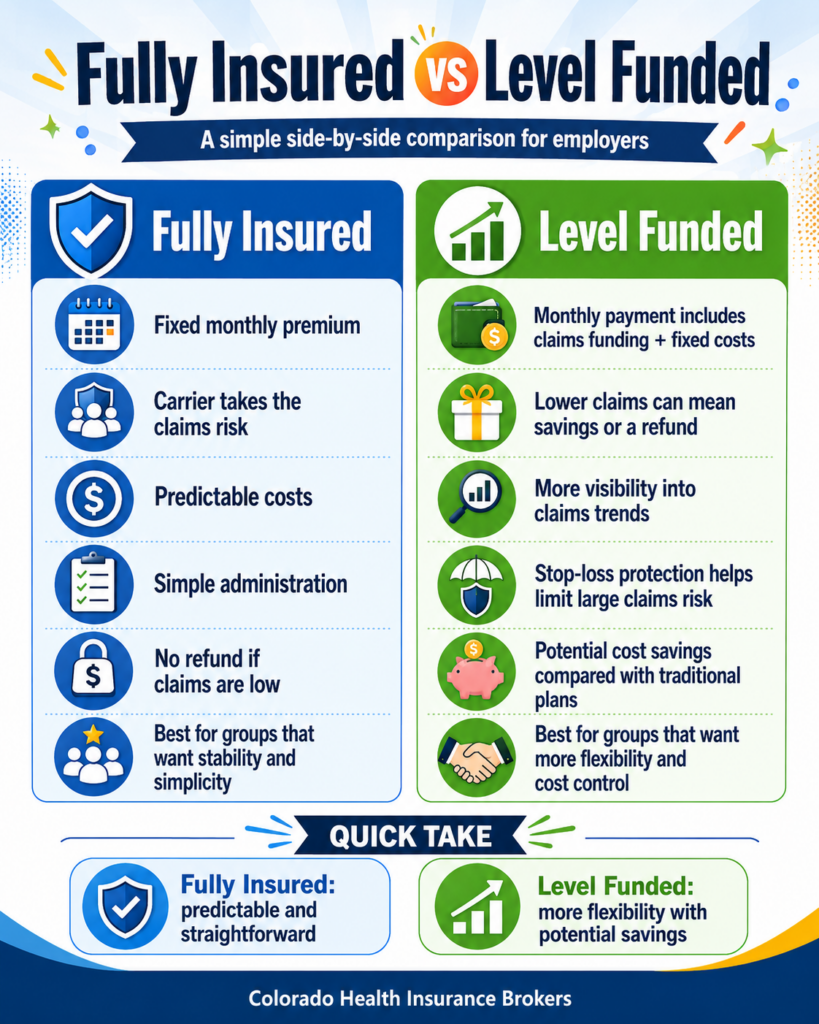
Fully insured: you pay a fixed premium, the carrier takes the risk
This is the traditional model. You pay a set monthly premium per enrolled employee. The insurance carrier collects those premiums and pays the claims. If your team has a terrible year — a couple of big hospital stays, an expensive specialty drug — that’s the carrier’s problem, not yours. Your cost is locked in for the plan year.
In Colorado’s small-group market, fully insured plans are “community rated.” That’s a term worth defining: the carrier sets your price based mainly on your employees’ ages and your location — not on how healthy or sick your specific group is. They can charge an older worker up to three times what a younger one pays, but they can’t raise your rate because someone on your team has diabetes or had surgery last year. For a small business, that protection is the whole point. One bad claim can’t single you out.
The trade-off: you don’t get rewarded when your team is healthy. If your group barely uses the plan all year, the carrier keeps the difference. You also pay state premium taxes and the carrier’s full administrative load baked into that premium.
Level-funded: a fixed monthly payment, but you can get money back
A level-funded plan is a hybrid. You still pay one predictable amount each month, so cash flow feels similar to fully insured. But that payment is split into three buckets: expected claims, administrative fees, and stop-loss insurance.
Stop-loss is the safety net — it’s coverage that caps how much you’re on the hook for if claims blow past projections. That’s what keeps a level-funded plan from turning into an open-ended risk for a 15-person shop.
Here’s the upside that gets people’s attention: if your team’s claims come in lower than projected, you can get a surplus refund at the end of the year. Healthy group, money back. With a fully insured plan, that surplus stays with the carrier.
There are two catches to be honest about. First, level-funded plans are medically underwritten — the carrier asks health questions up front, so your rate reflects your actual group. A healthy 15-person team often comes out 10–20% ahead of a comparable fully insured renewal. A group with significant claims may not qualify for an attractive rate at all. Second, level-funded plans are not subject to the ACA’s medical loss ratio rebate rules that apply to fully insured small groups, because you’re effectively funding your own claims. That’s not a downside exactly — it’s just a different set of rules.
So which one fits a 15-person company?
It really comes down to two questions.
How healthy and stable is your team? If your employees are generally young and healthy and your group is stable, level-funded gives you a shot at keeping money that would otherwise be the carrier’s margin. If your group is older, has known ongoing claims, or turns over a lot, the predictability and community-rated protection of fully insured is often the safer bet.
How would a bad year feel? With fully insured, a bad claims year costs you nothing extra mid-year — you’ve already locked your price. With level-funded, stop-loss protects you from catastrophe, but you want to understand exactly where that cap sits before you sign. The right plan is the one whose worst-case scenario you can live with.
There’s no universally “right” answer here, and anyone who tells you level-funded is always cheaper — or always riskier — is selling, not advising. The honest answer depends on your specific team and your tolerance for variability.
If you want, send us your current renewal and a rough age breakdown of your team, and one of our Agents will walk you through what each structure would actually look like for your numbers. No cost, no pressure — just a clearer picture before you decide. Get a Benefits Quote today.