
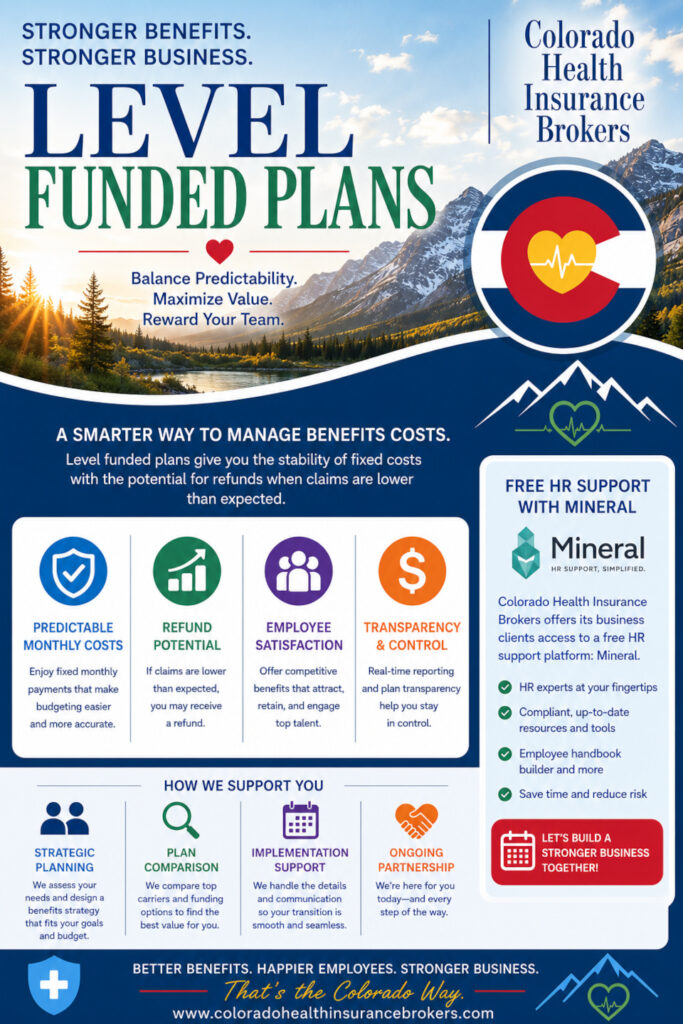
Level Funded Health Plans for Colorado Small Businesses
If your Colorado business has a healthy group of employees, you may be paying more for fully-insured health coverage than you need to. Level funded plans can offer healthier small and mid-sized employers savings of 30% or more compared to traditional ACA fully-insured group plans, with the added benefit of getting money back when claims come in low.
Below is a clear look at how level funding works, why it exists, and how to tell if it’s a good fit for your company.
A Quick Look at How Group Health Insurance Evolved
Group health benefits in America took off near the end of World War II, after the federal government began allowing the cost of these benefits to be tax deductible.
In those early years, employers paid workers’ medical claims directly out of cash flow. Because costs swing widely from month to month, only large corporations had enough cash flow to absorb that risk. Many large employers still operate this way today, in what’s known as a self-insured or level funded arrangement, because it costs less over time than paying an insurer to carry the risk.
Over the decades, laws like the Employee Retirement Income Security Act (ERISA) were passed to bring fairness and oversight to employee benefit programs.
Why Most Small Businesses Use Fully-Insured Plans
As healthcare costs climbed, most small and mid-sized companies were unwilling or unable to take on the risk of paying catastrophic claims, which can run from hundreds of thousands of dollars into the millions. To manage that risk, most small to mid-sized employers turned to an insurance carrier for a fully-insured group health plan.
With a fully-insured plan, the insurance carrier carries the risk of claims above your copays, deductibles and coinsurance, administers the claims processing, and charges you a monthly premium that bundles all of it together. To protect themselves against unusually large claims, carriers often contract with a reinsurance company to take on part of the risk above their own retention limit. That’s basically insurance for the insurance company.
Before the Affordable Care Act, carriers would survey each employee’s health and use that data to set premiums, a process called medical underwriting or rating. Groups with healthier employees paid less. At renewal, carriers used the prior year’s claims (called experience rating) to set the next year’s premium, sometimes raising rates dramatically or even denying renewal entirely.
How the ACA Changed Small Group Pricing
The Affordable Care Act requires fully-insured small group plans (up to 100 employees) to be priced using community rating, based only on:
- Age of each employee
- Tobacco use
- Location
- Family size
Pre-existing conditions can no longer be used to deny coverage or raise premiums, and small groups can’t be denied renewal because of their claims history.
That’s a real benefit for groups with less healthy employees. The downside is for healthier groups. Before the ACA, a small Colorado company with an unusually healthy workforce would receive a favorable rating and pay less than average. Today, with community rating, that same healthy group pays the same as a much less healthy group of the same age and demographics.
It’s important to understand that ACA small group restrictions only apply to fully-insured plans. Self-insured plans, including level funded plans, are governed by ERISA, which preempts state insurance regulations. That matters especially for multi-state employers headquartered in Colorado.
How Level Funded Plans Work
Because level funded plans aren’t regulated by the ACA’s community rating rules, the carrier can medically underwrite the group based on employee health questionnaires and claims experience. For a healthy group, that often translates to monthly costs 30% or more below a comparable ACA fully-insured plan.
Here’s the basic structure:
- Monthly payments. You make a fixed monthly payment, similar to a premium, to a Third-Party Administrator (TPA).
- A claims reserve. The TPA uses part of that payment to build up a cash reserve to pay claims.
- Stop-loss insurance. The plan includes stop-loss insurance to protect you from catastrophic individual or aggregate claims, similar to having a high-deductible policy backing up your reserve.
- Claims processing. The TPA processes and pays claims out of the reserve.
The fixed monthly payment is what makes it “level funded.” You aren’t hit with unpredictable monthly swings, even though you’re technically self-insured.
The Claims Reserve Advantage
This is where level funded plans get interesting for healthier groups.
The TPA underwriters set your monthly reserve payments to cover projected claims plus a moderate margin. If your group stays healthy and claims come in at or below projections, the reserve builds up a surplus.
After a defined period (often around 18 months), if that excess reserve hasn’t been needed, the surplus is returned to you.
Compare that to a fully-insured plan: the carrier maintains a claims reserve internally, but if there’s a surplus at year-end, it stays with the carrier. You never see it. With level funded, healthier years pay you back.
What About Renewals?
Because level funded plans aren’t governed by the ACA, renewals are based on your prior year’s claims experience and aren’t guaranteed.
If your group has an unusually high claims year, your renewal premium may go up, or in some cases the carrier may decline to renew. That sounds scary, but here’s the protection that makes level funding workable for small employers:
If a renewal doesn’t make sense, you can always move back to a fully-insured ACA-regulated plan, with guaranteed issue and community-rated premiums. No claims history can be held against you. Your employees keep coverage and you go back to the predictable pricing structure of a traditional group plan.
Is Level Funding a Good Fit for Your Colorado Business?
Level funded plans tend to work best for small and mid-sized Colorado employers with:
- A relatively young or healthy workforce
- Lower-risk occupations
- Stable month-to-month enrollment
- Interest in benefiting financially when claims come in low
For the right group, level funding can deliver substantial savings compared to a fully-insured plan, with the upside of a refund when claims stay low and the safety net of being able to return to an ACA plan if circumstances change.
Get a Level Funded Quote for Your Colorado Business
We’ll review your group’s situation and run quotes from the top level funded carriers serving Colorado, alongside a comparable fully-insured plan, so you can see a clear side-by-side comparison and decide what makes the most sense for your company.
For a small employer with a healthy, low-risk group, a level funded plan can provide substantial savings as compared to a fully-insured plan, with virtually no downside financial risk when properly structured. Get a quote for your small to medium sized business and find out if a level funded self insured plan is right for you.